


Driving theory test preparation in 6 countries
Learn the road rules. Then find out if you know them.
Camito teaches the road law of the place you are learning in, one short lesson at a time, then asks you about what you just read. Every answer is explained. The ones you get wrong come back until you get them right.
Instruction is delivered online, on your phone. Camito is test preparation and nothing else.
Where Camito teaches
58 courses, each one its own place’s law
A learner in Queensland learns Queensland’s rules and a learner in Texas learns Texas’s. Every course is written from the road law of the place it covers, and you pick yours when you open the app.
- Courses
- 58
- Countries
- 6
- Lessons
- 2,784
- Questions
- 37,120
United States43
- Alabama
- Alaska
- Arizona
- Arkansas
- California
- Colorado
- Connecticut
- Delaware
- District of Columbia
- Florida
- Georgia
- Hawaii
- Illinois
- Indiana
- Iowa
- Kentucky
- Maine
- Maryland
- Massachusetts
- Michigan
- Minnesota
- Mississippi
- Missouri
- Montana
- New Hampshire
- New Jersey
- New Mexico
- New York
- North Carolina
- North Dakota
- Ohio
- Pennsylvania
- Rhode Island
- South Carolina
- Tennessee
- Texas
- Utah
- Vermont
- Virginia
- Washington
- West Virginia
- Wisconsin
- Wyoming
Australia8
- Australian Capital Territory
- New South Wales
- Northern Territory
- Queensland
- South Australia
- Tasmania
- Victoria
- Western Australia
United Kingdom4
- England
- Northern Ireland
- Scotland
- Wales
Nationwide3
- France
- Germany
- Sweden
Courses for Austria, Slovenia and Switzerland are written too. Camito is not in those countries’ App Stores yet, so they are not counted here.
Counted from the course files every time this page is built.
How a lesson goes
Read a little, then prove it
A lesson is one idea, not a chapter. Seven minutes of reading, then a short test drawn only from what you have just been taught.
Read the lesson
One idea at a time, in plain words, with the picture that makes the rule obvious rather than a picture for decoration.
Answer ten questions on it
Only on what that lesson taught you. Nothing you have not been shown yet turns up in the test.
Read why, every time
Right or wrong, the answer comes with the reason and the section of the law it comes from. Getting it right by luck and getting it right by knowing look identical on a score, and they are not the same thing.
A wrong one comes back
Later in the same test, with the options shuffled, so you cannot get through by remembering where the right one was sitting.
It ends when you know it
Not after a fixed number of tries. The test finishes once you have answered every question in it correctly at least once.
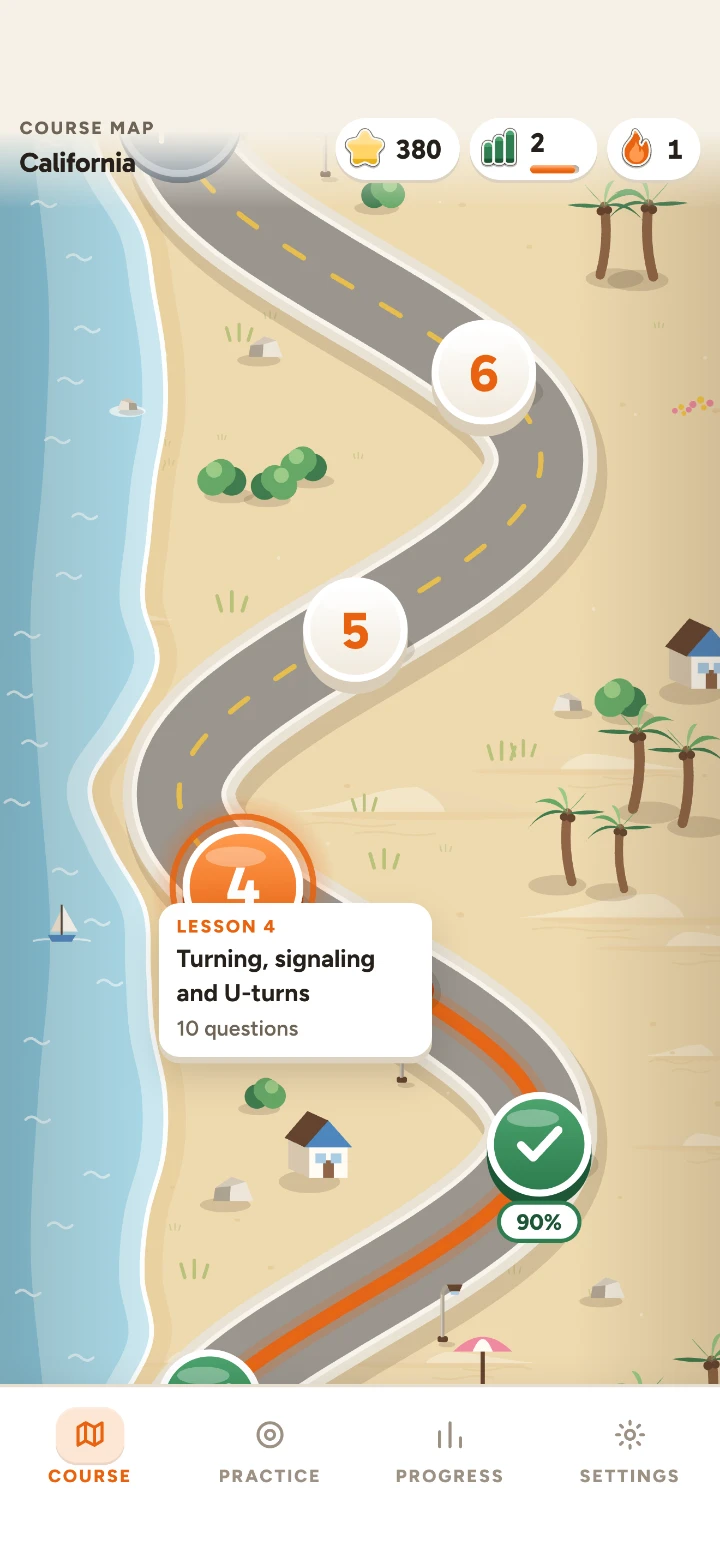
The course map
The whole course is one road trip
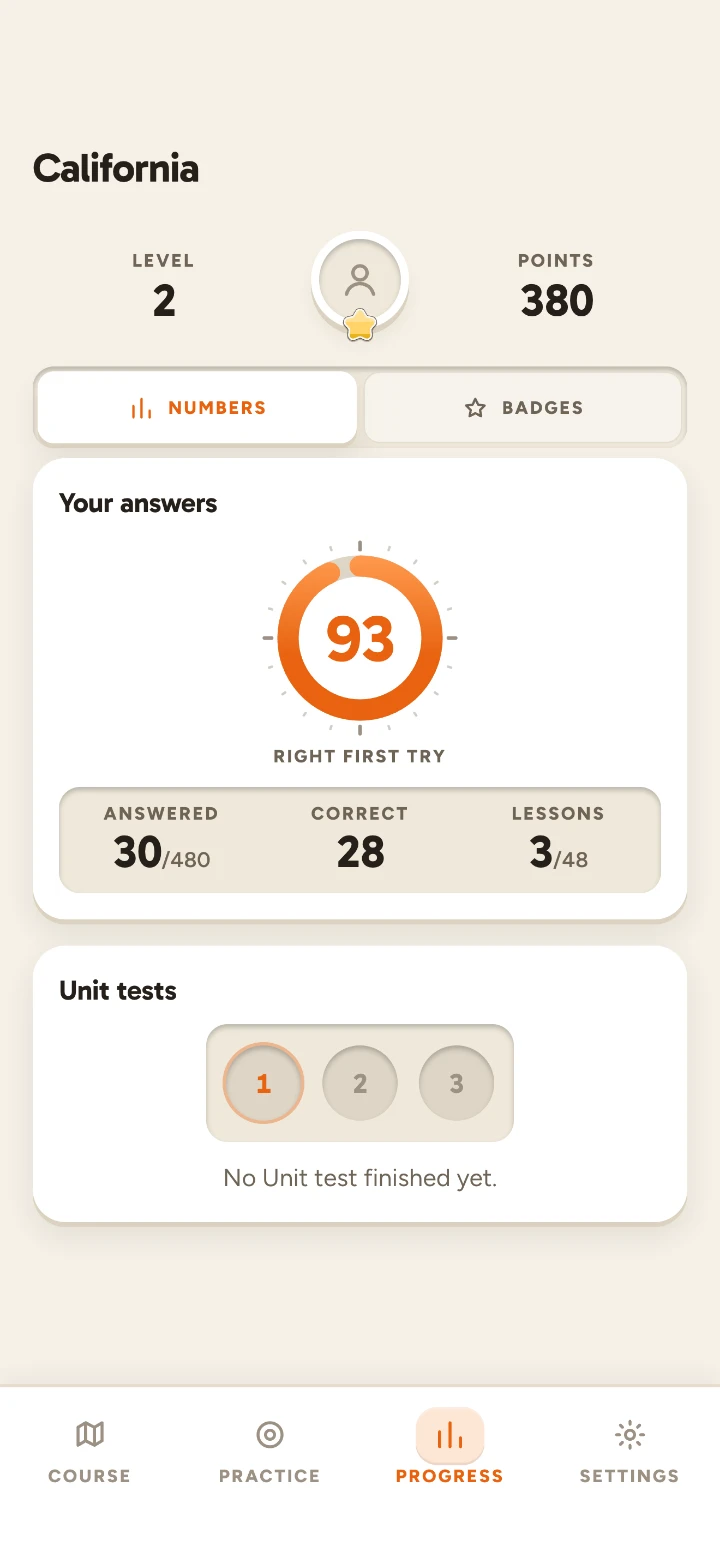
Every unit is its own stretch of country, every lesson is a stop on the road, and every unit ends at its test. Finish a lesson and the car drives on. Points, a level and the days you have studied in a row ride along at the top.
- MasteredEight of ten or better, first try.
- Needs reviewFewer than eight. Its questions come back.
- You are hereThe stop the car is parked at.
- Unit testWhere every unit ends.
- Not open yetOpens when the unit before it is passed.

Unit 1Coast
Right of way
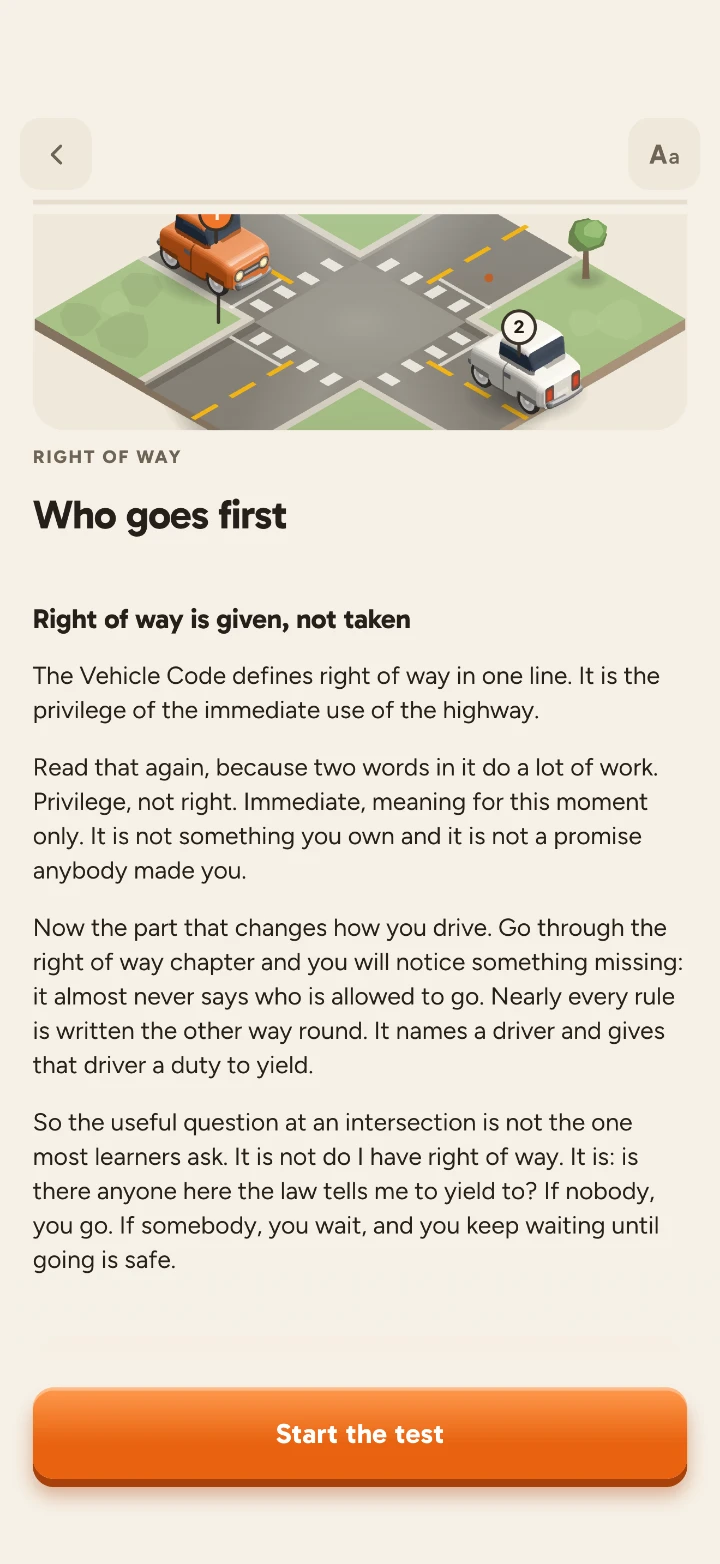
- Who goes first
- Reading a traffic signal
- Stop signs, yield signs and how signs are built
- Turning, signaling and U-turns
- Crosswalks, marked and not
- Emergency vehicles, school buses and crossings
- Unit test, 20 questions
Unit 2Desert
Signs, signals and markings
- Regulatory signs
- Warning signs
- Guide and service signs
- Yellow lines
- White lines, arrows and special lanes
- Signals and beacons beyond the basics
- Unit test, 20 questions
Unit 3Mountains
Speed, space and seeing
- The basic speed law and maximum limits
- Limits that depend on the place
- Following distance
- Space beside and behind
- Scanning, mirrors and blind spots
- Being seen and heard
- Unit test, 20 questions
Unit 4City
Lanes, turns and freeways
- Keeping right and choosing a lane
- Changing lanes and passing
- Right and left turns in detail
- Roundabouts and unusual intersections
- Merging, crossing and entering traffic
- Freeways: on, along and off
- Unit test, 20 questions
Unit 5Forest
Sharing the road
- Pedestrians beyond the crosswalk
- Bicycles
- Motorcycles, small and slow vehicles
- Large vehicles, buses and emergency vehicles
- Railroad and light rail
- School, crossing and work-zone signs
- Unit test, 20 questions
Unit 6Coast
Conditions, hazards and emergencies
- Night and glare
- Rain and flooding
- Fog, smoke, wind, snow and ice
- Skids and loss of traction
- Vehicle emergencies and dashboard warnings
- Road hazards, loads and work zones
- Unit test, 20 questions
Unit 7Desert
Fit to drive, and protected
- Alcohol and the legal limits
- Drugs, cannabis and open containers
- Under 21, and what a DUI costs
- Distraction and phones
- Fatigue, health and emotions
- Seat belts, child seats and children left in cars
- Unit test, 20 questions
Unit 8Mountains
Parking, collisions and the license
- Parking signs and curb colors
- Where you may not park, and parking on hills
- After a collision
- Insurance, registration and selling a car
- Permits and the provisional license
- Points, suspension and traffic stops
- Unit test, 20 questions
California’s course, counted from its files
- Units
- 8
- Lessons
- 48
- Questions
- 640
California’s course, counted from its files
- Units
- 8
- Lessons
- 48
- Questions
- 640
The thing we care most about
A score that is allowed to say no
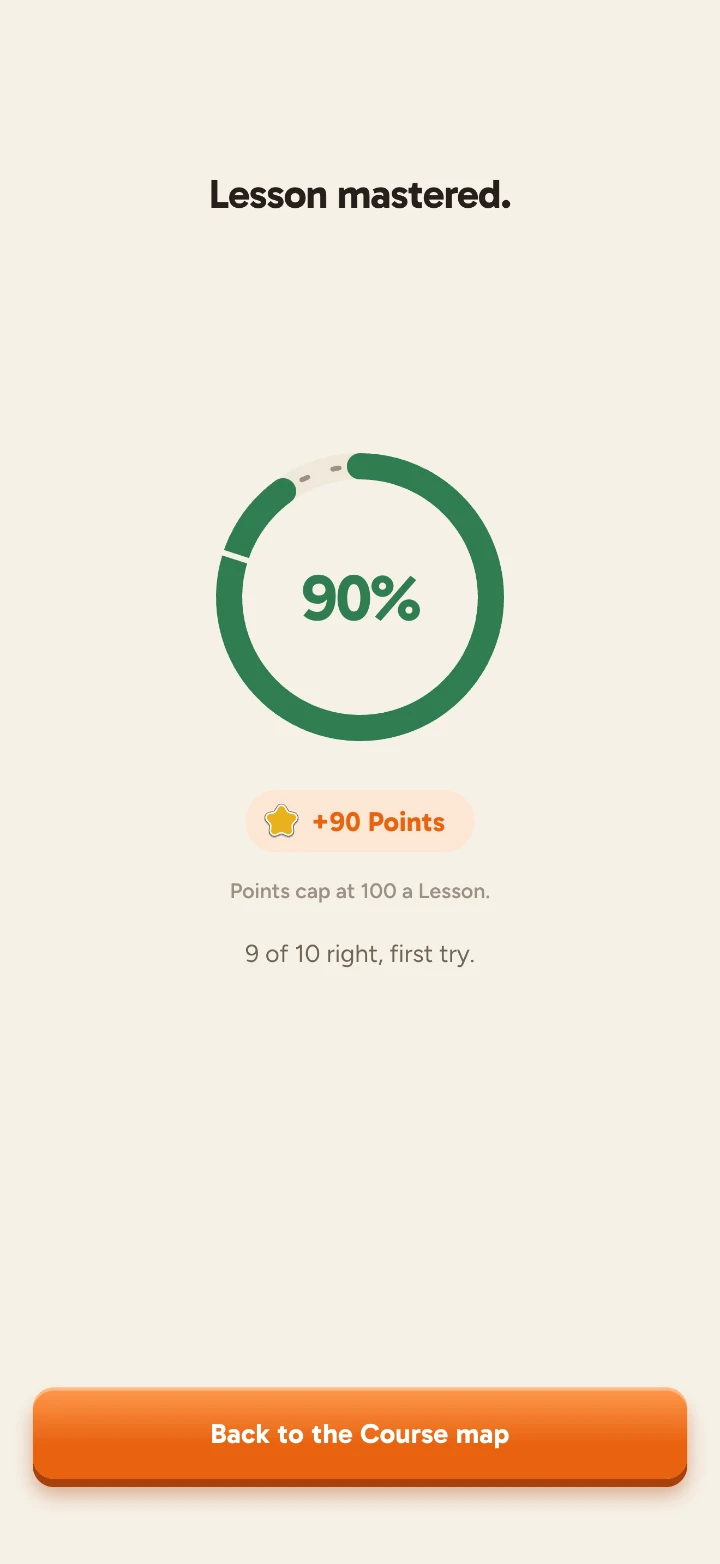
A lesson is ten questions, and you can miss two. Get eight right on the first try and the lesson is yours. Miss three and Camito marks it needs review rather than mastered, and those questions come back.
8 of 10
Mastered
First try, and it counts
The lesson counts as mastered, the points are yours, and the stop on the course map turns green.
7 of 10
Needs review
One short, and it says so
Camito names the three you missed and brings those questions back. Nothing is taken away from you and you lose no points you already earned, but the lesson does not get to call itself finished.
Gold, never red. A lesson you have not finished is not a failure.
A study app that records a lesson as complete when you got two thirds of it wrong has told a learner they are ready for a real legal test. It is the one thing a study app must never do, it is easy to do by accident, and it is done all the time.
That is the whole argument for Camito, and it is a small one. A score of 33 percent is not a lesson you have learned, and calling it one is worse than saying nothing, because the learner now has a reason to stop studying it.
Eight out of ten is also the standard a unit test has to meet, so there is one bar to clear and not two. The ten is part of the rule rather than a habit: at nine questions the same percentage would quietly demand eight out of nine, which is a harder test wearing the same number.
What a question actually does
The loop, five steps long
Points, a level and a streak ride along beside it, and none of them is the loop. The loop is the shortest path from not knowing a rule to knowing it, and the app runs it on every single question.
- Read it.
- Answer it.
- Find out why.
- See it again.
- Then it counts.
Where the questions come from
Written from law and driving guidance
We write original questions and explanations from the road law of the place they apply to. For driving techniques that applicable law leaves unstated, we use separately cited factual guidance from government sources. Every question keeps its source record.
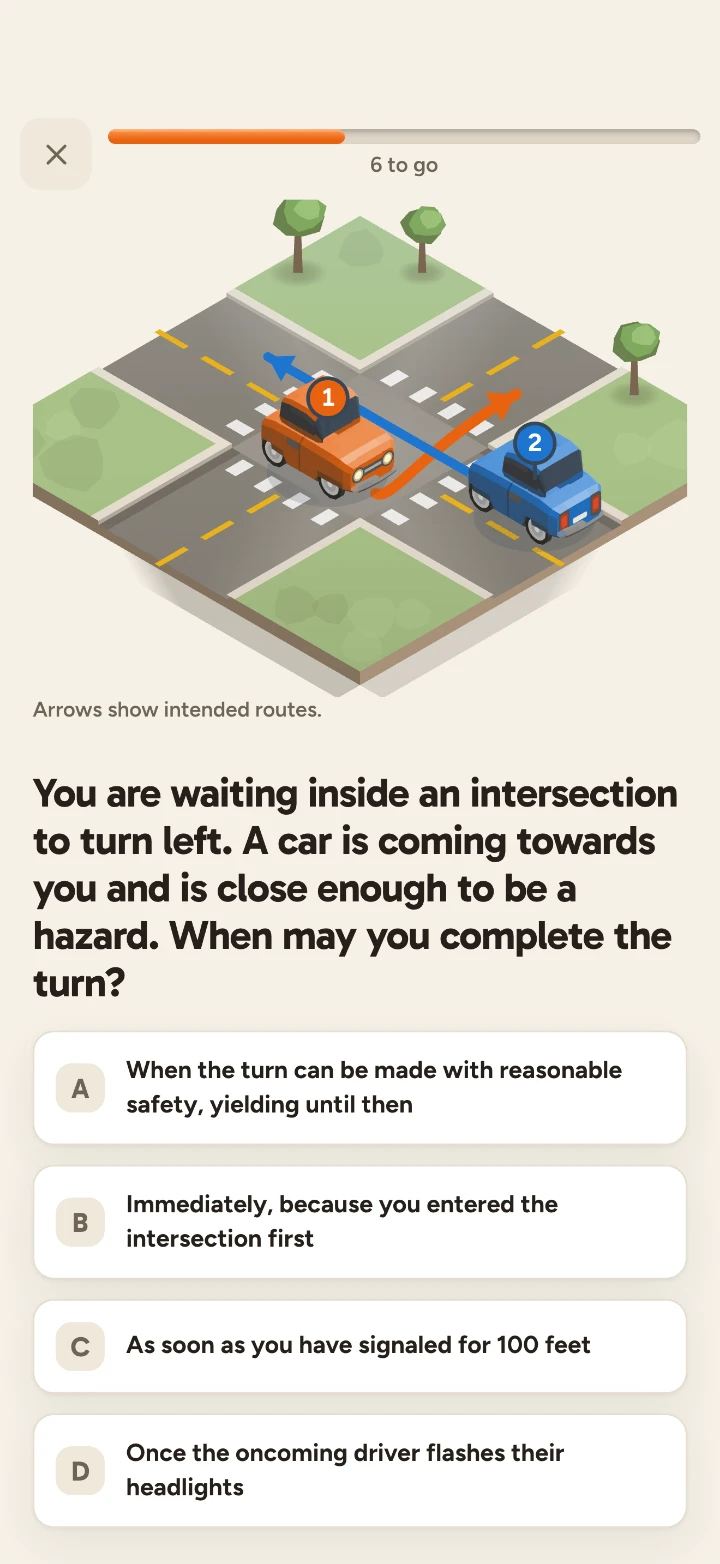
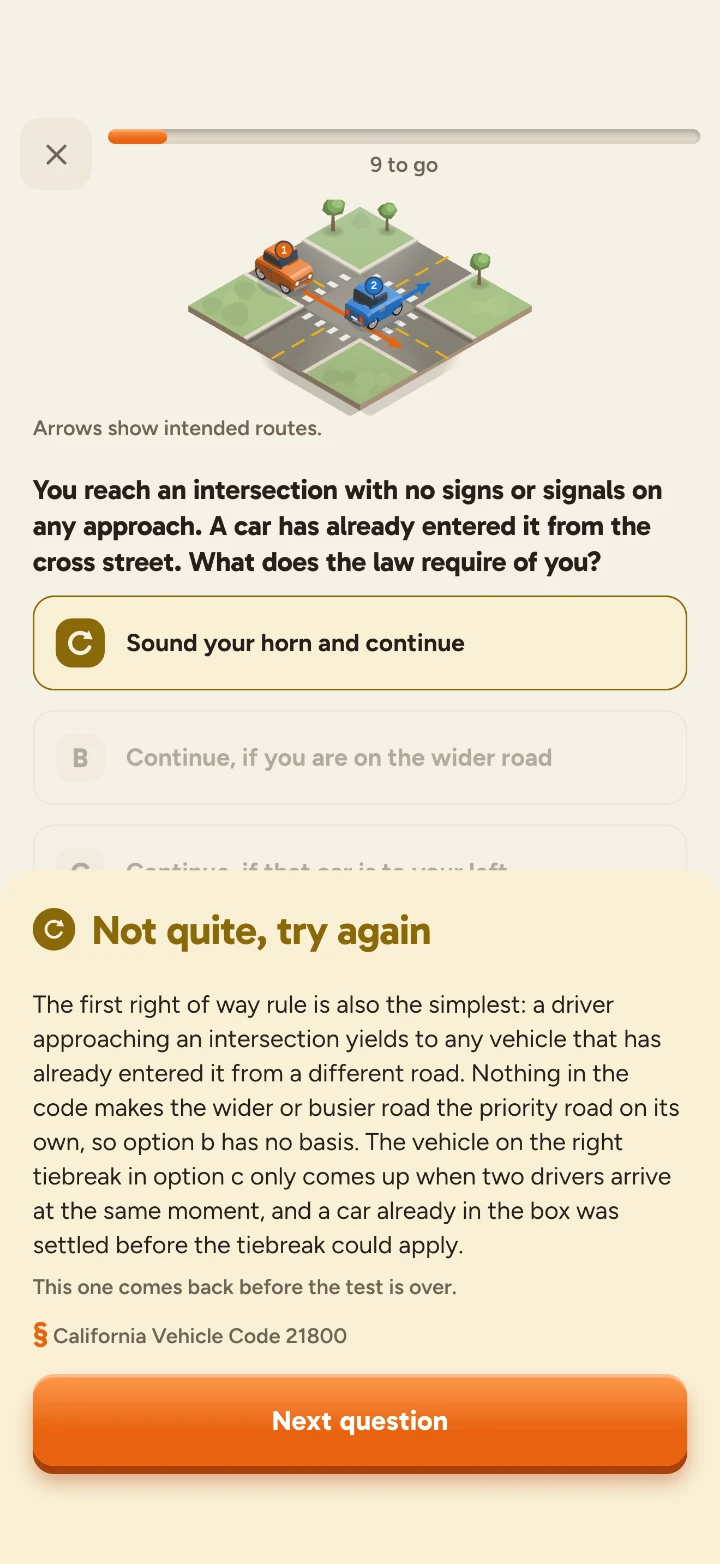
Lesson 1 · question 1 of 10
How does the California Vehicle Code define right of way?
That is not an example written for this page. It is the first question of the first lesson of California’s course, one of 58, read straight out of the course when this page was built, with the section of the vehicle code it was written from.
The first unit, counted from the course files
- Lessons
- 6
- Questions in the lessons
- 60
- Questions in the unit test
- 20
- Sections of law and guidance cited
- 47
Counted from this unit’s files every time this page is built.
These figures cover California, unit 1: Right of way. Its lessons and unit test contain 80 questions in total. The playable lesson is the first lesson in that unit.
One source record per item
For each item we record which jurisdiction it belongs to, which instrument it came from, which section, which edition, the date we read it and who checked it.
We never guess a jurisdiction
If we have not written a place’s course yet, Camito does not offer that place a course. Showing you a confident answer that is another place’s law is worse than showing you nothing.
Found something wrong?
Road law changes and people make mistakes. Tell us and we will check the item against its source and fix it. Write to us.
Things we will not tell you
What Camito does not claim
Study apps in this category say some remarkable things. Here is where we stop.
No government approval, of any kind
Camito is not a government agency and is not connected with one. No licensing authority has approved, endorsed, certified or partnered with Camito, and we do not issue permits, licences or certificates.
These are not the real test’s questions
We write our own questions from local road law and separately cited government factual guidance for driving techniques the applicable law leaves unstated. They are not the questions on the real test and they are not taken from it. Anybody who tells you they have the real questions is telling you something else.
No pass rate, no pass guarantee
We publish no pass rate, because we have not run long enough to have one of our own and we will not borrow anybody else’s. We offer no money-back pass guarantee.
We cannot promise you will pass
Nobody can. What Camito can do is teach the material and show you honestly what you have and have not learned, which is the part that is actually within reach.
Before you ask
The short version
Eight things that are true, that people ask anyway, and that are each written out in full somewhere else on this site.
- Wrong answers come back
- Every answer explained
- The section of the law, cited
- Works with no signal
- One subscription, no ladder
- Free trial, no free lesson
- The price is in the app, not here
- Nothing to post, nobody to talk to
All of it is on the questions page, with the qualifications attached.
What it costs
One subscription, and it opens all of it
Here is what you study with in Camito. The subscription opens all of it, and there is no part of it you can have without one.
Lessons
One idea, then ten questions on it.
A wrong answer
Explained, then asked again.
Unit tests
The same eight out of ten to clear.
Practice
A mixed set drawn from anywhere.
Road signs
The reference, shape by shape.
What is locked
All of it, until you subscribe.
What you get before you pay
None of the course, apart from a free trial if you start one. Camito asks you to subscribe or start the trial before it opens the course, and that screen stays up until you subscribe or restore a subscription you already have.
There is no free lesson, no sample and no preview. We would rather you read that here than find it out on your phone.
What the subscription opens
- Every lesson, from the first one
- The unit tests
- Practice
- The road signs reference
The terms, in plain words
One monthly subscription. There is no plan ladder and nothing to compare. It renews every month until you cancel it, and you cancel it in the App Store, where you bought it.
Every icon above is the one the app shows you.
We do not print a price on this page. The App Store sets the amount in your own currency for the country your Apple Account is in, and it is not the same number everywhere. You see the exact amount, the billing period and the date of the first charge inside the app before you buy anything, and again on the App Store’s own payment sheet.
Who it is for
Learners, and the adult who agreed to it
You can use Camito from 13
Learning the rules starts well before you are old enough to hold a permit or a learner licence, and in some places that comes at fourteen. If you are under 18, a parent or guardian has to agree before you use Camito.
If you are the parent
Camito is a study app, not a social one. There is nobody to talk to inside it, nothing to post and nothing to buy except the one subscription. What we collect and why is written out in full, including the parts we have not settled yet.
We do not sell anybody’s data
Not yours, and not your child’s. If that ever changed it would be written on the privacy page before it happened, not after.
Ready when you are
The road is the same for everybody. The studying is not.
Camito is on the App Store now, for iPhone and iPad, and not on Google Play yet. You see the price for your own country inside the app before you pay anything.

Questions first? The ones people actually ask.
Written in Ljubljana, for learners in 6 countries.